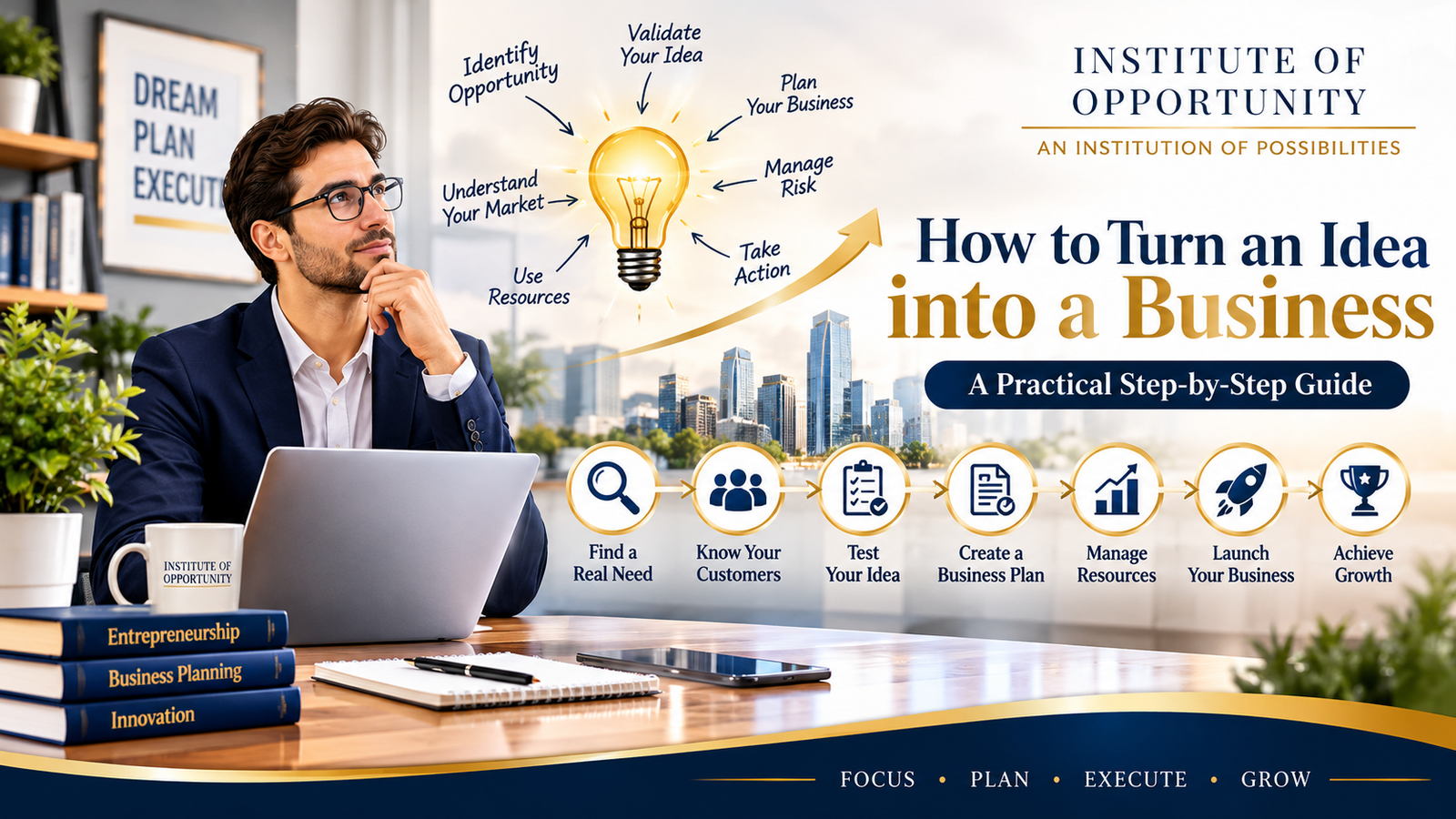
An interesting idea can change the way you see a problem. Turning that idea into a business, however, requires considerably more than enthusiasm. It calls for an understanding of customers, a realistic assessment of demand, careful planning, financial judgment, and the ability to put a concept into practice.
Learning how to turn an idea into a business begins with an important distinction: an idea describes something that could exist, while a business provides something people genuinely value and are willing to support. The distance between those two points is where research, experimentation, and decision-making become essential.
Many promising ventures begin with ordinary observations. Someone notices that a service is inconvenient, a product does not meet expectations, or a particular group of customers is struggling to find a suitable solution. What initially appears to be a small frustration may reveal a larger commercial possibility.
The challenge is learning how to investigate that possibility before investing too much time, money, or effort.
At the Institute of Opportunity, developing this ability begins with recognizing potential and continues with understanding how to act on it. Building a business is one practical way to apply those principles.
1. Begin with the Problem Rather Than the Product
One of the most common mistakes aspiring entrepreneurs make is becoming attached to a product before establishing whether anyone needs it.
A business idea may sound innovative, but originality alone does not establish commercial value. Customers are generally interested in whether something improves their circumstances, saves time, reduces difficulty, offers convenience, or provides a benefit they cannot easily obtain elsewhere.
Begin by describing the problem your idea intends to address.
Consider a simple example. You are thinking about launching a service that helps small businesses manage customer enquiries. Before designing an application or hiring developers, investigate how businesses currently handle incoming messages. Are enquiries being missed? Are employees duplicating work because information is scattered across different platforms?
The answers will help you determine whether the problem is significant enough to justify a solution.
This is closely connected to how to identify unmet customer needs. Rather than assuming what customers want, investigate their experiences and understand the difficulties they encounter.
A strong business proposition usually begins with a clearly understood need.
2. Identify the People Who Would Buy Your Solution
A business cannot serve everyone equally well, particularly when it is starting with limited resources.
You need to identify the people most likely to benefit from your proposed product or service. These individuals form your initial target market.
Consider:
Who experiences the problem most frequently?
What characteristics do these potential customers share?
Where do they currently look for solutions?
What alternatives are they already using?
What would encourage them to consider a different option?
Are they willing and able to pay for an improvement?
Avoid describing your audience too broadly. Saying that a product is intended for everyone makes it difficult to understand who should be approached first.
For example, a business offering appointment-management services might initially focus on independent clinics, consultants, or local service providers rather than attempting to serve every industry.
A defined audience makes research, marketing, pricing, and product development more manageable.
3. Research the Market Before Making a Commitment
Personal conviction is not market evidence.
You may believe your idea solves an important problem, but the market may already contain several alternatives. Customers may also be comfortable with their existing arrangements, even if those arrangements are imperfect.
Market research helps you understand the environment in which your business would operate.
Examine:
Existing competitors: Identify businesses offering similar products or services. Study their pricing, customer experience, strengths, and limitations.
Customer expectations: Find out which features or benefits matter most to potential buyers.
Market conditions: Consider industry developments, purchasing habits, economic conditions, and changes that could influence demand.
Available alternatives: Remember that your competition may not be another company selling the same product. Customers might solve the problem manually, use an unrelated service, or decide that the problem is not worth addressing.
Research should help you answer a practical question: is there a sufficiently attractive reason for customers to choose your solution?
For further insight into this process, connect this section to the Institute's article on how to identify an opportunity.
4. Understand What Makes Your Idea Different
A new business does not necessarily need to invent an entirely new category. It does need a convincing reason for customers to pay attention.
Your advantage might come from greater convenience, a more accessible price, better service, a specialized audience, improved reliability, or a simpler customer experience.
Suppose several companies already provide bookkeeping services. A new business might focus exclusively on freelancers who need straightforward monthly support and predictable pricing.
The service itself is not entirely new. Its positioning and delivery may nevertheless address a specific customer requirement more effectively.
Ask yourself:
What does my proposed business provide?
Which customer problem does it address?
Why might customers prefer it?
What can I deliver particularly well?
Can I maintain that advantage as the business grows?
This is your value proposition. It should explain the practical benefit of choosing your business without relying on exaggerated promises.
5. Test the Idea Before Building the Entire Business
You do not need a finished product to begin learning from potential customers.
In fact, developing everything before testing the central assumptions can create unnecessary expense. A small experiment may reveal weaknesses while they are still relatively inexpensive to address.
Depending on the nature of your idea, you could:
Interview potential customers.
Present a sample design or demonstration.
Create a basic version of the service.
Offer a limited pilot.
Test a landing page that explains the proposed offer.
Invite potential buyers to respond to a clearly described proposal.
The purpose is not simply to collect compliments. It is to discover whether people understand the offer, consider it useful, and demonstrate genuine interest.
Pay particular attention to behaviour. Someone saying an idea sounds excellent is not the same as someone agreeing to test it, requesting a proposal, or making a purchase.
Testing turns assumptions into information.
It also connects with the principle behind opportunity recognition skills: learning to distinguish an attractive possibility from one supported by meaningful evidence.
6. Build a Business Model That Makes Commercial Sense
Having a product people find useful doesn't guarantee you have a business that can last.
You need a clear picture of how the business will make money and how much it will cost to run.
A business model explains how an organization provides value to its customers and how it makes money from doing so.
Consider the following elements:
Revenue: Will customers pay a one-time purchase price, a subscription, a recurring service fee, or a project-based charge?
Costs: What will you spend on materials, labour, software, marketing, premises, delivery, administration, and other operating requirements?
Pricing: Does the proposed price reflect customer expectations, the value provided, and the cost of delivering the offer?
Delivery: How will customers receive the product or service, and what resources will be required?
Repeat business: Is the offer likely to generate ongoing purchases, referrals, or longer-term customer relationships?
Prepare realistic estimates rather than relying on optimistic projections. Include expenses that are easy to overlook, such as payment processing, maintenance, taxes, insurance, and customer support.
Your business model should make it possible to explain how the venture can operate financially, not simply how it might attract attention.
7. Calculate the Financial Requirements
Before launching, establish how much money the business may require and where that money will come from.
Start by separating initial expenses from ongoing operating costs.
Initial expenses may include equipment, product development, registration, professional services, website creation, or inventory. Continuing expenses might include salaries, rent, utilities, subscriptions, advertising, and distribution.
Then estimate your expected income under different scenarios.
A useful financial plan considers at least three possibilities:
Conservative: Sales develop more slowly than expected.
Expected: Revenue follows a reasonable estimate based on available evidence.
Optimistic: Customer demand develops more quickly than anticipated.
Do not build your decisions around the optimistic scenario alone.
Consider how long the business could continue operating if revenue takes time to develop. Identify the point at which income covers operating costs, and understand how much working capital may be necessary.
Where appropriate, consult an accountant or qualified financial adviser about taxes, reporting obligations, and business structure.
Financial preparation does not remove uncertainty. It helps you understand the consequences of different outcomes.
8. Create a Practical Business Plan
A business plan should provide direction, not become a document that delays every decision.
It translates the idea into a sequence of manageable activities.
A useful initial plan includes:
Business concept: Explain what you intend to offer and the problem it addresses.
Target customers: Describe the people or organizations most likely to purchase it.
Market research: Summarize customer feedback, competitor findings, and evidence of demand.
Value proposition: Explain why the proposed solution deserves consideration.
Revenue model: Describe how the business expects to generate income.
Operating requirements: Identify the people, equipment, technology, suppliers, and processes needed.
Marketing strategy: Establish how potential customers will discover the business.
Financial estimates: Outline expected expenses, revenue assumptions, and funding requirements.
Milestones: Set practical targets for testing, launching, and reviewing performance.
Keep the plan proportionate to the business. A small service venture may need a relatively straightforward document, while a capital-intensive operation requires more extensive preparation.
The objective is clarity. You should be able to identify what needs to happen next and why.
9. Decide How to Launch
A business launch does not have to be a large public event.
For many new ventures, a controlled introduction is more useful. It allows you to observe customer behaviour, identify operational difficulties, and improve the offer before expanding.
You might begin with a limited geographical area, a small group of customers, a restricted product range, or a short pilot period.
Establish what you want to learn during this stage.
For example:
Can customers understand the offer?
Are enquiries converting into sales?
Can the business deliver consistently?
Are actual costs close to your estimates?
Which questions or objections arise repeatedly?
What improvements do customers request?
A measured launch can protect resources while producing useful information.
Once the business demonstrates that its offer and operations are workable, you can consider expanding its reach.
10. Build a Customer Acquisition Strategy
Even a well-developed product will struggle if potential customers never discover it.
Your marketing strategy should explain where your audience spends time, what information influences its decisions, and how your business can reach it.
Depending on the market, useful channels may include:
A professional website.
Search-engine-optimized educational articles.
Social media platforms.
Email communication.
Industry events and networking.
Referral partnerships.
Local advertising.
Direct business outreach.
Choose channels based on customer behaviour rather than attempting to use every available platform.
Your website should communicate the offer clearly. Visitors should be able to understand what the business does, who it serves, and how to make an enquiry or purchase.
Useful educational content can also help build credibility. Articles addressing customer problems, explaining relevant processes, and answering common questions allow potential buyers to assess your knowledge before contacting you.
For additional perspective, see listening skills for entrepreneurs. Understanding the questions and concerns customers express can make communication more relevant and effective.
11. Learn From Early Customers
The first customers provide more than revenue. Their experiences can reveal whether your original assumptions were accurate.
Ask them about the purchasing process, the usefulness of the product, and any difficulties they encountered.
Do not restrict feedback to positive comments. Complaints and repeated questions can highlight weaknesses that may otherwise remain unnoticed.
For instance, customers might appreciate the main service but find the booking process confusing. Improving that process could make the overall experience more valuable without changing the core offer.
Look for patterns rather than treating every individual comment as an instruction.
This is where how to identify unmet customer needs becomes relevant again. Customer feedback may reveal requirements that were not apparent during the initial research stage.
A business should remain willing to improve as its understanding develops.
12. Recognize Risk and Prepare for Setbacks
Every business involves uncertainty. The important task is to understand the risks and decide how they can be managed.
Potential challenges include:
Lower-than-expected customer demand.
Higher operating expenses.
Delays from suppliers.
Strong competitor responses.
Difficulty recruiting or retaining staff.
Changes in regulations.
Technology or operational failures.
Insufficient cash flow.
Assess which risks could have the greatest effect on the business. Consider how likely they are, what consequences they could produce, and what preparations might reduce their impact.
For example, relying on a single supplier may create vulnerability if that supplier experiences disruption. Identifying an alternative source could reduce the exposure.
Avoid treating risk assessment as a reason to abandon every uncertain idea. It is a way to make informed decisions about what you are prepared to undertake.
The Institute's program How to Capitalize on an Opportunity explores the relationship between evaluating risk, planning, resources, and execution.
13. Develop the Discipline to Keep Moving
Starting a business involves many activities that are less exciting than developing the original idea.
There are customers to contact, records to maintain, problems to solve, expenses to monitor, and decisions that cannot always be postponed.
Consistency becomes important.
Create a working schedule and identify a few priorities that contribute directly to progress. Review your objectives regularly and distinguish between activity that moves the business forward and activity that merely keeps you occupied.
Protect time for important tasks. Constant interruptions can make it difficult to complete demanding work or examine problems properly.
The principles discussed in how to improve focus and distraction and missed opportunities are relevant here. Attention influences the quality of your decisions and your ability to notice changes in the market.
A business does not grow simply because its owner remains busy. It develops through purposeful work directed towards meaningful objectives.
14. Know When to Adapt Your Original Idea
Your first version of a business concept may not be the version that customers ultimately value.
Research and experience can reveal that a different audience has a stronger need, a particular feature matters more than expected, or the original pricing structure is difficult to sustain.
Adaptation should be based on evidence, not constant uncertainty.
If customers repeatedly request a particular improvement, investigate whether it fits the business's capabilities and commercial objectives. If a product is attracting interest but not converting into purchases, examine the reasons before assuming that more advertising is the answer.
Remaining committed to the purpose of solving a real problem does not require remaining attached to every detail of the original idea.
15. Measure Progress and Build for Sustainable Growth
Once the business is operating, establish how you will assess its performance.
The right metrics will vary with the business model, but they can include:
Number of enquiries.
Conversion rate.
Revenue and operating expenses.
Customer acquisition costs.
Repeat purchases.
Customer retention.
Delivery times.
Customer satisfaction.
Cash flow.
Avoid measuring success through revenue alone. A business can generate substantial sales while experiencing weak margins, operational difficulties, or poor customer retention.
Review performance at regular intervals. Compare actual results with your original assumptions and identify where adjustments are needed.
Growth should be supported by operational capacity. Expanding too quickly can create service problems, cash shortages, or pressure on the people responsible for delivery.
Sustainable development means building a business that can continue to provide value while managing its resources responsibly.
16. Frequent Pitfalls to Steer Clear of When Starting a Business
Several avoidable mistakes can weaken an otherwise promising concept.
Building before researching: Developing a complete product without understanding customer demand can waste resources.
Assuming everyone is a customer: An unclear target market makes marketing and product decisions unnecessarily difficult.
Ignoring competitors: Existing alternatives can reveal customer expectations, market standards, and areas where your offer needs to improve.
Underestimating expenses: Incomplete financial estimates can create pressure long after the launch.
Confusing interest with demand: Positive reactions do not necessarily translate into purchases.
Trying to grow too quickly: Expansion before the business is operationally ready can damage customer experience and financial stability.
Refusing to adapt: Protecting an original idea at the expense of customer evidence can prevent improvement.
Recognizing these mistakes early gives entrepreneurs a better opportunity to make measured decisions.
17. From an Idea to a Business - A Practical Sequence
If you are considering a new venture, use the following sequence as a starting framework:
Describe the problem your idea addresses.
Identify the people who experience it.
Research existing solutions and competitors.
Establish what makes your offer useful or different.
Test the idea with potential customers.
Develop a realistic business model.
Estimate costs, revenue, and financial requirements.
Prepare a practical business plan.
Launch on a manageable scale.
Collect feedback and improve the offer.
Monitor financial and operational performance.
Expand only when the business is ready.
The process is not necessarily linear. New information may require you to revisit earlier decisions. That is a normal part of developing a business.
The important point is to replace guesswork with investigation and turn broad ambitions into specific actions.
The Institute of Opportunity - Developing the Ability to Recognize and Act
Turning an idea into a business involves two connected capabilities: identifying a worthwhile possibility and developing the judgment to pursue it.
The Institute of Opportunity is built around these abilities. Its educational approach encourages people to examine their surroundings, recognize unmet needs, evaluate possibilities, and consider how to put promising ideas into action.
Its two programs address different stages of this process.
How to Identify an Opportunity
This program develops the ability to observe more carefully, recognize unmet needs, examine possibilities, and evaluate whether an idea deserves further consideration.
How to Capitalize on an Opportunity
This program focuses on assessing risk, preparing a practical plan, organizing resources, and moving from an identified possibility towards execution.
Each program lasts approximately 3 to 4 hours and includes a certificate of completion. Either program costs $100, while both can be taken together for $150.
Participants can choose the program that best matches their current learning needs or enrol in both.
The Role of West Wing House
The Institute's educational philosophy is connected to the wider ecosystem of West Wing House, which has developed multiple business concepts and opportunities.
The Institute places education first: developing the ability to recognize possibilities and make more considered decisions about them.
Any potential involvement in a West Wing House business opportunity is considered separately and subject to its own evaluation and terms. Participation in an educational program does not guarantee access to a business opportunity, commercial success, or financial returns.
Learning can improve preparation, but the outcome of a business venture depends on many factors, including market conditions, resources, decisions, and execution.
Conclusion - Give Your Idea a Genuine Chance to Grow into a Business
A promising concept is a starting point, not a finished enterprise. Its future depends on whether it addresses a genuine need, attracts customers, makes financial sense, and can be delivered consistently.
Understanding how to turn an idea into a business means learning to move beyond enthusiasm. It requires research, customer conversations, careful evaluation, realistic planning, and the willingness to improve when new evidence becomes available.
The process also begins with the ability to recognize potential. An overlooked problem may reveal a market need. A better way of doing something may develop into a valuable product.
If you want to strengthen these abilities, explore the educational programs offered by the Institute of Opportunity.
Visit https://instituteofopportunity.com/apply to submit an enrolment enquiry, or contact info@instituteofopportunity.com. The enquiry form requests your name, email address, occupation, business or organization, and preferred program. The team shares enrolment and scheduling information separately. Payment is not collected through the website.
Conceived at the West Wing House. Powered by the Institute of Public Companies.